Choosing a setting
A public TCM hospital or a wellness clinic
You will hear both names — hospital and clinic — used loosely. They are not the same morning. One is a public outpatient floor with numbers on a screen. The other is a smaller room, often quieter, often priced differently. We pick with you once we know what you want from the day. This is how we think about the difference, without pointing at a door.
What “hospital” means on this site
A public TCM hospital is a large building with departments, a registration hall, and a pharmacy. The department you want is one door among many. Staff have seen foreigners before in some of these places and almost never in others. We only suggest ones that are used to international visitors, because the alternative is a morning spent explaining the passport again.
The advantages are the ones people who live here already know: the setting is ordinary, the process is the real one, and the hospital’s own charges sit in a public range. The costs of that honesty are also ordinary — a queue, a loud corridor, a consultation that does not linger because the next number is waiting.
What a smaller clinic feels like
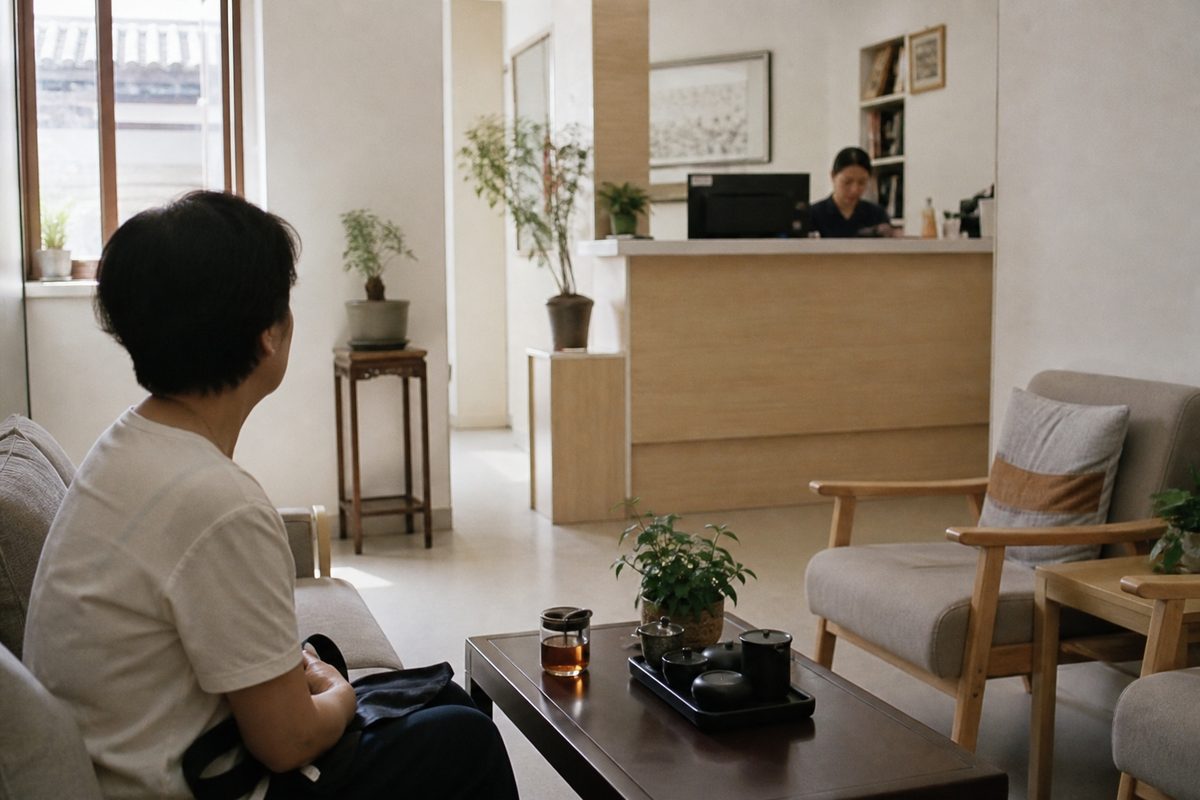
A wellness clinic is usually one practice, or a few rooms. You may wait on a sofa rather than a bench. The practitioner may have more minutes. The bill is still theirs, not ours, and it is not automatically lower. Sometimes it is higher, because you are paying for time and quiet. Sometimes it is simpler, because there is one till and no pharmacy labyrinth.
Clinics vary more than hospitals do. Some are set up for visitors. Some are a neighbourhood room that happens to have an extra chair. We will not send you to the second kind and call it atmosphere. If a clinic cannot do the paperwork in a way that makes sense for a passport holder, it is the wrong room, however calm it looks.
Queue, language, and a first visit
If this is your first time in a Chinese medical building, the hospital morning is the one that teaches you the system — which is useful if you might come back alone, and tiring if you only have one free half-day. A clinic can be kinder on the nerves. It can also hide how the rest of the city actually works. Neither is morally better. They suit different days.
Language load is higher in a hospital because there are more people to speak to: the card window, the nurse at the door, the pharmacist. That is exactly when a companion earns the fee. In a small clinic the same person may take your coat and your pulse. Interpreting still matters. The number of conversations is just smaller.
Price band, not a bargain pitch
Hospital items typically sit in the ¥80–385 range, with a realistic upper bound around ¥1,200–¥1,750 if several things happen. A clinic may quote a package for the room. We still separate our fee from theirs. We still tell you the hospital or clinic figure before you agree to an extra.
We will not claim one setting is “better care.” We are not a medical provider and we do not compare practitioners. We compare friction: how you get a number, how long you sit, whether a passport is routine, and whether you will understand the bill. You decide if that trade is worth a quieter sofa.
How we choose with you
You tell us what the day is for. A first look at how a mainland public outpatient floor works points toward a hospital that already sees visitors. A short stop between meetings, or a preference for fewer people in the corridor, points toward a clinic that can do the paperwork. If we cannot find a room that fits the week you have, we say so. We do not invent a third category and call it exclusive.
Whichever door we suggest, the companion’s work is the same: registration, the wait, the conversation, the bill, the summary. The building changes. The job does not. If you already know which setting you want, write it on the form. Preference is not a promise we can always meet, and we will say when it is not.
